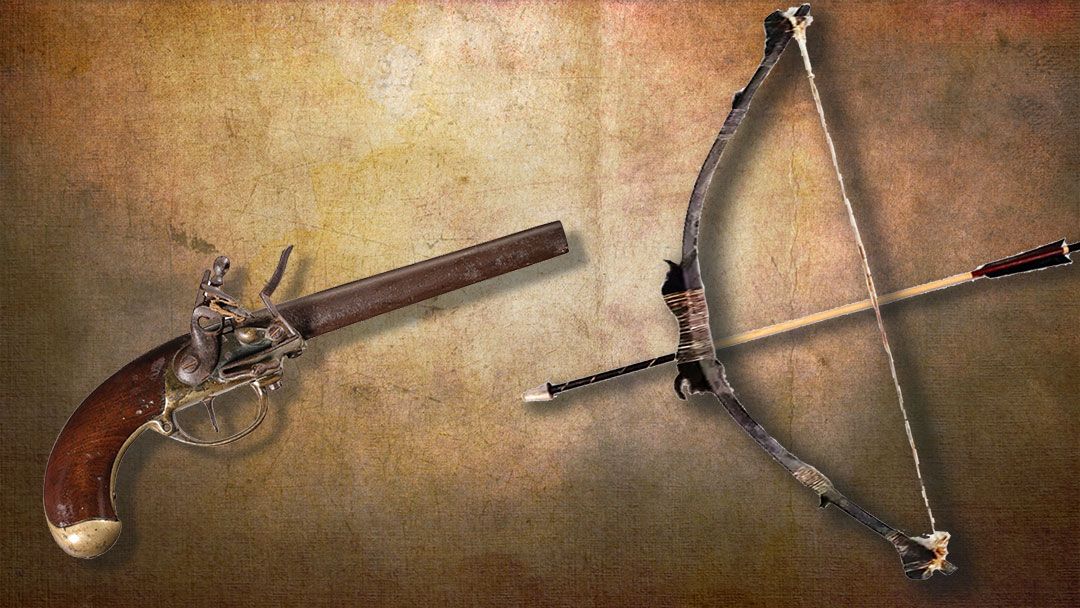
Common story about bows and guns goes as follows: in ancient times people used bows and swords, then guns were invented and we switched to a newer better weapon, case closed. Actual story is more nuanced. When guns first appeared, archers did not like them at all and did not switch. In limited capacity bows continued to be used even into 19th century: Russia employed Kalmyk arches in its army but did not train native soldiers in archery. Yet guns did prevail in the end. So, what did actually happen, is gun really better than bow or is it something else.
Bow
To begin with, let's look at the bow. It looks like a very simple weapon with just two parts, plus ammunition. What tricks could this thing possibly hide? Here appearance is misleading as bow is not as simple as it looks. The trick is in bowstring, in its tightness to be precise. How tight the bow string should be?
Here there are two mutually exclusive answers. On one had bowstring should be just tight enough so that a person could easily pull it. What will be the point of bow with a bowstring that is too tight for a person to use it? Simple enough? Not so much actually. A bowstring that is too lax will not be able to propel the arrow with significant enough force to actually penetrate the body of an enemy, much less their armour.
What is the solution then: make bow string as tight as possible so that it will pack a serious enough punch and actually kill its target? However again a bowstring this tight and strong will be hard to pull even for the strongest of men, making such bow near unusable. Catch 22 situation.
The problem with the bow is the fact that strength and speed with which bow can propel an arrow is determined by the tightness of the bow string. Make it flexible enough for every person to use and you will get a pea shooter that will not kill anyone. Move in the opposite the direction and make it tight enough to pack serious punch and hardly anyone could use it. What is the solution to such a strange and unobvious at first glance dilemma?
During Middle Ages the best arches were people who grew up using bows. Mongols used their bows for hunting and every Mongol learned how to use is since early ages and used it continuously. Years of constant practice made them accustomed to powerful recoils of their bows and by adulthood they could use a very powerful bows with little effort. Abovementioned Kalmyk archers used both Mongolian bows and tactics and were descendants of Mongols too, it was good enough to survive into 19th century.
Across the continent, in distant Wales, Welsh/English Longbowman did fundamentally same thing as Mongols. There is huge difference in materials, size and construction methods between Welsh Longbow and Mongol Composite bow, but one thing both have in common is the fact that in order to master it, one has to start training at early age, and it takes years to master it. Welsh stated training at age of 7 in order to be able to fight as longbowman by the age of maturity.
That was is, English and Mongols had good arches with superior bows, who could and did make history. Meanwhile everyone else plainly sucked at using bows and their archers were irrelevant as they could not kill anything with their smaller weaker but easier to use bows.
Even for English and Mongols however not all was sunshine and roses. Long training and complex secrets behind making bows made longbowmen impossible to replace. Should the battle go bad and archers will be decimated by the enemy, commanders could not just recruit more man and train them to use bows. They had to wait decade or two until new generation of archers will come of age. If you ever wondered why 100 Years' War would occasionally be interrupted for couple of decades only to resume later, now you know. Too many archers died and English took a pause waiting for their replacements to come of age. To call this not ideal from military perspective would be an understatement.
To make matters worse, their rarity and exclusivity gave archers significant leverage over King. King needed them and could not easily replace them. Archers used this fact to extract various privileges from the crown. In Medieval England, privileges of yeomen (legal term for longbowman) were second only to knights and by extension lords (read more of it here), they were a special caste, rarer and more important than pandas nowadays. But there was nothing kings could do about it, or is it?
Crossbow
Italians figured out how to solve the bow problem with the power of engineering. Why train forever and use frail human strength to pull impossibly strong bow string when you can build a machine to do it for you. That is how they made crossbow.
Modern idea of a crossbow, that you occasionally see in movies, is that of essentially a bow-pistol that shoots bold rather than bullet. Medieval crossbows, especially most powerful and effective ones, were nothing like that. They were huge and cumbersome machines, with metal rope bow string and a prod. To cock it the crossbowman used a special device called cranequin or windlass, that looked like pedals for a bicycle. There were simpler designs too, but they were also less powerful. More info
here.
The best Genovese crossbow set, that also included protective pavise, was both very effective but also very costly. It also required work of a skilled weapon maker, who understood complex physics and more. That was not something that was available in every country at that time. Thus, good deadly crossbowmen were also limited a few localities in northern Italy and everyone else had to do with much weaker crossbows.
Guns
There is a saying that rifle made everyone equal. After reading the following passage, you will understand why.
Modern guns have magazines with many bullets (cartridges), some can fire automatic or at least semi-automatic. Early Medieval Guns were nothing like that, they were but a plain tube with hardly any parts at all. They required pouring powder down the barrel and then push bullet down the same barrel, using metal rod. To fire one had to ignite powder using burning cord, called match, by pushing it through a small hole in the barrel. After firing one had to clean the barrel before reloading again. To make matters worse they were inaccurate and unreliable, frequently injuring the shooter. To say seasoned longbowmen and crossbowmen were not impressed would be an understatement. The gun was worse than their weapons in every possible way. It was not a boomstick but dumbstick.
If guns were so bad, then why did they managed to replace superior bows and crossbows? The answer is cost and simplicity. Gun was much easier and cheaper to manufacture than a crossbow. Arquebus did not require complex gunsmithing and expertise, the Genovese crossbow did. One makes arquebuses not only cheap but also many. Even a simple smith without much gun making knowledge and experience could put the tube together.
Using it was much easier than both longbow and even crossbow. Powder propelled the bullet, making strength, or lack of, of the user irrelevant. That made it much more accessible. Now everyone could train to be a shooter in very short time. That made replacing lost soldier much easier. Decade long pauses in wars became thing of the past. Now kings could recruit and train as many arquebusiers as they needed. Not only that but anyone could actually become proficient with the gun at any age.
Conclusion
Guns replaces bows not because they were better weapons, but because they were cheaper and easier to use. Guns made everyone equal: with guns anyone could be deadly on the battlefield. With swords and bows, the outcome of battle was almost always a foregone conclusion in favour of better trained and equipped. Guns managed to shatter this status quo, giving underdogs a fighting chance. War become cheaper and more accessible. More and more people would become soldiers. That increased casualties too. However, war stopped being a thing for upper classes only, with commoners had little choice but to accept whatever the outcome was. Now common people could fight for their interests with guns in hand.
Bows and crossbows or people proficient with them did not disappear overnight, however. At first, they became elite units in the new army, later they became royal bodyguards and eventually ceremonial guards.
Yeoman of the Guard, as name suggest, were once longbowmen. They still exist a be it no longer use longbows.
This is how we went from bows and swords to guns. One can notice parallels between this and AI for example. Even if AI is not better than real programmers, the fact that every idiot and their dog could use it, unlike actually writing code that requires years of education, will make AI widespread and it will gradually replace many other more specific roles.


No comments:
Post a Comment