Putin's regime like to propagate a narrative that 'wild 90s' were horrible times and that life was better before. While there indeed were certain problems during 90s and certain things were better during Soviet times that preceded them, fundamentally this narrative is incorrect. For majority of people, life in USSR was overall worse than during 90s. Ultimately people freely chose to keep 90s system over going back to how things were before.
As much as communists like to claim 1996 elections were rigged, they were not. A bit more than 1/3 of all people voted for Zyuganov to return to how things were, but more than half voted against returning to past even if it meant keeping the 90s system. This was the ultimate verdict to Soviet past. No matter how much those voted for Zyuganov wanted to deny that, this is the truth.
I will agree that for those individuals, who voted for Zyuganov life did got worse and they had good reasons to want to go back. However those who voted for Yeltsin had equally good reasons to resist return to the past and their views should not be ignored or dismissed out of hand like current regime and their apologists like to do.
I already wrote an article detailing life during 90s where I admitted some flaws but also outlined what that era gave Russia and its people. Now I will cover the Soviet era that preceded it and outline problems that ultimately destroyed USSR.
In the past I did wrote a few articles outlining certain aspects of Soviet system. Not everything was bad and certain things were so good even reasonable people not emotionally attached to communist values might want them back. However on the summary Soviet times were bad. So bad people chose to end them when they god a chance and did not want to go back when given a second choice either.
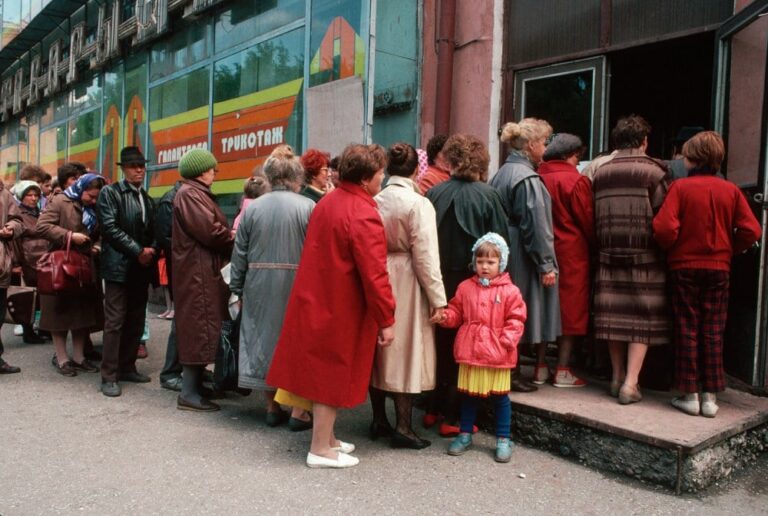
The elephant in the room is of course consumer goods, or lack of them to be precise. Even before completely empty shelves of late 80s, choice in Soviet stores was scarce. Yes, defenders will claim that you could find things and that essentials were there, but that misses the point, or to be precise dismisses it.
Critics of 90s like to say that while during 90s goods were in stores, but people had no money to buy them, in 80s and 70s it was the other way around. People had money but there was nothing to buy, making whole money seem pointless.
Sure having essentials are good, but people want more than that, they want to thrive and have fun. If system does not provide them with that, they will not be happy. That will gradually sip away at the whole system.
Soviet consumer goods policy was deliberately astute, frugal at best, scarce at worst. Consumer goods spending was controlled by people with similar mindset to Puritans and monks. They believed that all sort of excesses is bad and provided public only with goods they deemed either healthy or necessary in amounts they deemed sufficient. Their rigorous crusade against anything wasteful and vain, that will make western recycling freaks look tame in comparison, severely limited goods available to public.
Yes there were inefficiencies in the systems, mistakes as well as scalpels who too advantage of scarcity to make quick buck or to provide for themselves and their relatives and friends at expense of general public, but this problem would not have happened if there were enough goods to begin with.
Public on average found that woefully insufficient. Because of that black economy thrived. Smugglers, that in western world only deal in prohibited substances like narcotic drugs, provided Soviet public with all sort of goods, from t-shits and jeans to western movies and electronics. As absurd as it sound, prudes that ran Soviet consumer goods policy saw spending on even such simple things like print t-shits or soft drinks vain and wasteful. People who run consumer goods were more prude that most fundamentalist Christians in the West and they controlled what common people had legal access to.
That applied to entertainment too. Censors would only approve of movies and other media if they have a certain benign influence on public, either teach them something or promote Soviet way of life. They were so harsh that even an innocent purely entertaining movie with no political message will not see light of the day if it promotes vanity or does not instil communist work ethics. Lack of instilling Soviet values in some way was in itself seen as anti-Soviet or pro-Western. It's like saying that if does not promote Jesus then its Satanic and anti-Christian, but that was reality of Soviet entertainment. What could be shown in 'Christian manga' also could not be shown in communist movie and more. Here too smugglers filled the void with western media, that only served to endear public towards western way of life. Yes, there are a few Soviet era movies that public genuinely love but there were far too little of them.
Consumer goods and entertainment were the ultimate foundation of Soviet collapse. Even Soviet own comedy show Yeralash made fun of it in the sketch where Western spy tries to escape from Soviet border guards and offers a Soviet kid a chewing gum in exchange for help. Kid refuses by saying that spy should have at least offered him western sneakers because he is not so cheap as to betray his country for mere chewing gum.
As much as defenders of Soviet system would like to blame the kid, liberals and all other sellouts for lack of patriotism and western decadence as well as call for all of them to be send to Gulags, ultimately, it's not the "sellouts'" fault. If people will betray your country for a pair of sneakers, that is ultimately your system's fault. Blaming it on traitors' lack of morals, loyalty and patriotism is both wrong and foolish. It's your system that failed to provide these people with something that will give them stake in it so that they will have vested interests to protect it from foreign spies. There is nought to blame but the system. No matter how much you would lambast traitors from rostrums and beef up repression, people will still find ways to betray your system if it serves their self-interest. The more you repress them, the more satisfaction they will deliver from betraying your system. Some might even do it for free just out of spite for their treatment at the hands of the regime.
Your system is as good as what people will betray it for, if they betray it for a chewing gum, then its weaker than chewing gum. Do not underestimate the power of a gum. It deserves its own meme.
That raises the question: could USSR have survived if it spends more on consumer goods. Surely CPSU could have cut on space program or military projects to find enough money to raise standards of living and essentially bribe people to stay on their side. They could even replace people in charge of consumer goods with someone more hedonistic, willing to splurge a lot more.
Both yes and no.
Yes, bribing people will keep them on your side. Spending more on consumer goods will keep people happier and they will be more reluctant to abandon the system in favour of something else. Yes, people choose Western model (capitalism) because it promised them more consumer goods.
Does it ultimately solve the problem, no.
Why not? To answer that question, you have to look at reasons why USSR did not provide its people with enough consumer goods to begin with.
To put it simply they saw no need. If you tell a Soviet apparatchik that lack of chewing gum will destroy USSR, they will laugh at your face. Consumer goods or citizen satisfaction was always treated as least important thing in undemocratic corridors of power. Top brass always thought of their lofty ambitions and ignored people and their needs. They always though, but what these people going to do about it. They always believed people have no choice or agency.
Until in 1991 people proved them that they do matter. Lack of chewing gum did destroy a nuclear armed superpower.
Modern commies are no better as they clearly have not learned from their past mistakes and still believe people will sacrifice for their goals and values. Their continued support for Cuba and Palestine is enough of a proof that they learned nothing and will repeat the same mistakes if ever in power again.
Can then a democracy fix socialism by providing political competition to the party of principles by offering a more hedonistic alternative to communist orthodoxy? A goulash socialism. In theory yes, real democracy can better represent actual needs and desires of population and keep society stable. In practice again no. The reason for that is the attitude, communists have towards society.
Fundamental reason why Soviet system was doomed from the start, lies on even more fundamental level. It comes to ultimate attitude; communists have towards people. Communists see people not as customers to please or partners to negotiate with, but as children they have to educate. They erroneously believe that people can simply be taught what is good and what is bad, what to do and what not to do and they will do as their 'teachers' taught them too. This is both patronising and insulting.
Fundamentally this teacher student relationship does not work as a basis of government. People hate being treated like children, no matter how much communists hate this fact, it is the reason why fundamentally every communist regime is doomed to failure. One can run a cult this way because members are all fanatics like you are who believe in the same thing you do. However its impossible to run a country full of all sorts of people the same way. Society will push back and destroy your system every single time.
To run a country and be loved one must treat people as customers, esteemed guests, or at least theater audience. One most constantly please them to retain their favour. When Caesar talked about 'bread and circuses', he meant this simple fact. Capitalism wins over communism not because people love rich or support inequality, but because capitalists understand this simple truth, well not so simple it seems. Communism pays too much attention to weaknesses of capitalism and because of that completely fails to understand its strength.
If not pleased, then people has to be negotiated with, haggle if you like. Its like in CGPGrey Video, Rules for Rulers, you must keep key supporters happy and if not love you on election day, at least prefer you to the alternative. To get people on your side one must offer them something they would want in return for their support or work. Democracy is ultimately all about this very negotiating and higgling over all sorts of things. Political parties offer all sort of policies that benefit certain groups of people to get these people to vote for them. Prime ministers negotiate with MPs and ministers as well as with foreign powers and so on.
Here one should not see key supporters in a narrow sense. That is unless you run a two-roads dictatorship like Equatorial Guinea where only oil industry contributes to economy. In a complex modern society every member contributes something which makes every member a kay supporters. A Soviet joke illustrates it well. They pretend they pay us and we pretend we work. If you want your economy to actually perform you need these people to actually work, not just pretend they do. Thus you have to treat them as key supporters, negotiate with them and offer them something good enough for them to put real effort into what they do. Without their real effort and contribution your society will always turn into second Cuba or Venezuela and they simply will not put any real effort, unless they were sufficiently compensated, bribed if you like, for what they do.
Because of the above, people with teacher's mentality, who seek to educate masses, is in principle unsuitable to run a county. In fact, they are unsuitable to run anything outside of some hobby clubs.
As in Rules for Rulers video, a ruler has to balance needs of his key supporters and negotiate with them to get things done. Thus a person suitable to be a ruler is a shrewd negotiator who can figure out just what they could offer to all sorts of people in their system to keep them on their side. And it has to be a good deal too, one can get away with a scam when all one need is someone's money, but if one wants to run a country one has to offer ending deals that will remain good even as times go because people will find a way to get off the train the moment they start to think the deal is no longer good.
Because of the above, Soviet System had no real chance of surviving. Through sheer luck CPSU managed to bribe society with promises of brighter future where everything will be free and in abundance. However it failed to deliver and people will not fall for the same trick twice. Fundamentally it was no better than religion with its promise of heaven in the afterlife. Despite mutual animosity, Christians and Communists are the same kind of fraudsters.
Thus in order for Socialism to work, Socialists have to address all of the above issues and afterwards win back people's trust that they will not screw it like they did last time. That is a tall order and it will not get any easier. Fundamentally they are better off abandoning their system and get behind UBI that actually has chance of winning. People may be simple but they are not stupid. They want free shit, not bullshit and communists are alas full of the latter and short on the former.