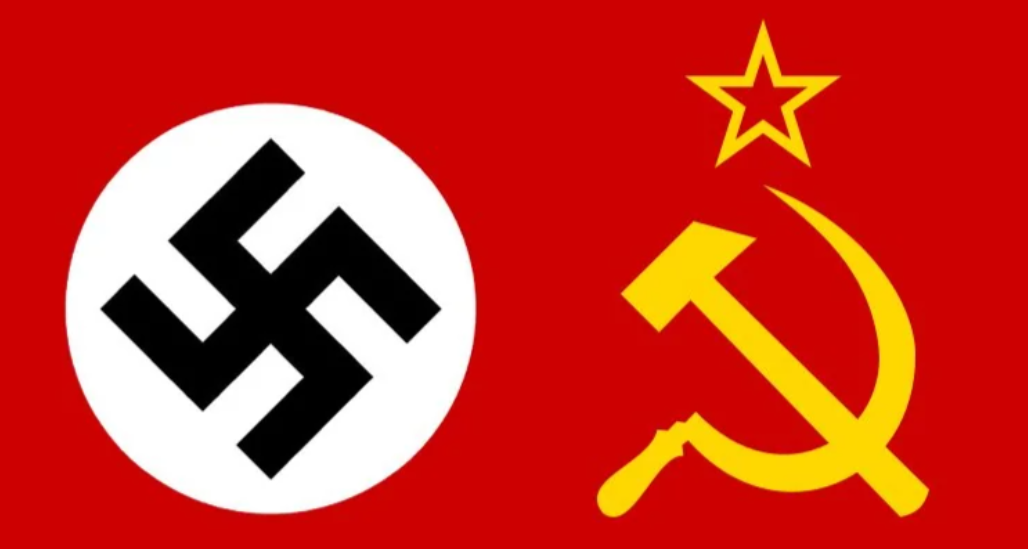
A while ago I watched a video where someone asked about why Communists and Nazis hate each other, pointing at many similarities between two ideologies. The hosts replied by insisting they are very different but otherwise failed to provide adequate explanation on how exactly different they are. So I decided to fill the void and answer this question for them.
Similarities
To begin with, similarities, which are many. From a perspective of a Western or a Liberal person or in fact any neutral and unbiased observer, Communism and Nazism are very similar. Fundamentally they both are dogmatic, totalitarian ideologies, insisting that their rules are both universal and objectively moral, thus they feel justified in using violence to enforce these rules. They are illiberal, and openly deny people a freedom to not only do as they see fit, but to also think differently. Finally they both believe that certain group of people is undesirable for the common good and should be exterminated.
To that end both groups run secretive secret police that oppressed the population. Both run concentration and extermination camps. Both murdered millions of people based on their ideological criteria. Installed puppet regimes in various countries that followed their dogma and more. The list is long.
Fundamentally both were (or possibly are) akin to a religion. No matter how ridiculous their believes are to the outsiders, they follow them through with religious zeal, devotion and dedication.
However, much like with religion, all these similarities do not make these two ideologies like each other. All they see are not similarities but glaring differences.
Take religion for example. Jains forbid its followers from eating beef and Islam forbids them from eating pork instead. Would they see it as grounds for common understanding and sympathy. No. Far from it they will both praise their own restrictions as moral, just and objectively good, while decrying these of the other religion as silly, barbaric and unworthy of any decent human being. These differences might even become grounds for a religions war to put an end to practices of that other religion.
Things do not get any better even if restrictions are the same. Both Judaism and Islam forbid their followers pork. They have many other similarities too. However that does not lead towards peace and understanding between Israelis and Arabs in Middle East. In theory Islam even acknowledges both Judaism and Christianity as older versions of their own religion and see both Moses and Jesus are prophets in Islam, predecessors of Prophet Muhammad. Finally Hebrew and Arabic have common roots as both are Semitic languages that split from one common language. None of that however makes relationship between Arabs and Jews any better.
In the same way, no matter how similar Communism and Nazism is, for their followers they are completely different and they hate their opponents with burning passion.
Differences
As for the differences they mostly come to three things: their stance on nationalism, criteria on who deserve to be exterminated and their treatment of women. Further down on fundamental level they come to different origins of both movements as part of their animosity to each other comes from that too.
I will begin with latter, origin history of both ideologies.
Communism originated from a socialist movement and was one of its splinter ideologies. You can read details of how that happen in my article about socialism. While all socialist splinter ideologies represent workers interests in conflict of interests between workers and their employers, they differ in actual approach to the problem. Social Democracy adopted conciliatory approach to this problem in form of negotiating with employers for better conditions for employees. Communism instead adopted confrontational approach by declaring all employers to be villains, deserving of physical extermination based on the fact that they own businesses and employ labor to work for them. To that end communists nationalised all businesses, all land and often murdered their former owners.
Nazism did not split up from socialist movement but was partially inspired by it. Nazism was created not by workers (hourly wage laborers who did not own property) who were behind all forms of socialism, but by disconnect WWI soldiers who felt betrayed by Versailles Treaty that ended WWI. Soldiers liked promises of care and support that socialism offered to working class as that reflected their own views of obligations that state owes to those who fought for it. However soldiers could not accept the notion that enemy they so bitterly fought on the battlefield is not their enemy but a comrade in their common struggle against capital. Thus they created a nationalist version of socialism, that combined promises of care for one's own with nationalism and animosity to foreigners as well as various traitors to the state and other enemies. National Socialism.
This difference in origin is part of the reason who Communists and Nazis do not like each other. Soldiers that created Nazism blamed socialist workers for betraying their country by toppling Kaiser and thus forcing Germany to accept humiliating Versailles Peace. Workers on the other hand never particularly trusted military, often seeing them as enforcers of capitalist order.
Globalism vs Nationalism
That leads us towards question of nationalism. Socialism was mostly anti-nationalistic in nature. Often it emphasized international solidarity and collaboration. From socialist perspective workers face the same challenges no matter where in the world they are located and thus have lot more in common with each other than with those of other social classes. To advance worker's cause socialists created an international association, to unite all socialists across the globe into a single socialist organisation. Even when they split up into several different splinter groups, it was not based on nations but based on different views. Socialists were broadly globalist and mostly opposed to nationalism. Even nowdays when they oppose global liberal order, they do so not as nationalists but as alter-globalists instead, insisting on different global order rather than on national isolationism. It is truly ironic that this ideology produced some of the most isolationist states in the world like North Korea and Cuba.
During WWI more moderated socialists made peace with idea of nation state and supported their nations in war. Communists however went completely opposite way, decrying war as a capitalist ploy to pit workers against one another and called on workers to sabotage war effort to bring down capitalist world order. Communists adopted are more explicitly anti-nationalist stance. Declaring that different nations and countries are artificial creations, invented by capitalists to divide working class against one another. Communists called on working class to renounced any allegiance to these artificial constructs and instead embrace globalist solidarity with fellow workers all over the world. USSR deliberately avoided any Russian or any other national references on its flag, emblem and other state symbols. Sickle and hammer are tools of trade for the working class, globe on the emblem represent globalism and even its official motto: "Proletarians (workers) of all countries, unite." all emphasize this stance. Soviet globalism was particularly apparent during early days of its existence. However even during WWII and later Cold War, when USSR begun decrying 'cosmopolitanism' and lack of loyalty to the country, it never accepted nationalism, always substituting it for patriotism instead. According to communist values, there can be loyalty to the state (because state is socialist and benign compare to other states) but not to a nation (because nations are but petty tribalism, unbecoming of developed socialist man). Nationalism was always viewed negatively and equated with Nazism. There was always a state sanctioned solidarity with "oppressed working class" in capitalist countries.
Needless to say such views on nationalism did not sit well with Nazis at all. For Nazis nation was a cornerstone of everything they believed it. Loyalty to not only one's state but one's people was paramount. Nazis decried Jews precisely because they are not connected to Germany in any particular way but rather sort of global phenomenon that exists in all countries and maintains common traits and loyalty to each other rather than nations they reside in. Nazis viewed this lack of connection to Germany as reason why Jews betrayed Germany and subjected it to Versailles humiliation. That later became grounds for Holocaust as well as extermination of similarly unconnected Gypsies and communists, who due to their ideology did not see nation as important enough.
The rest of Nazi ideology all comes from this worldview that puts nation (a collection of people connected by blood) as fundamental structure of society. Different nations and their cultures were assessed and evaluated on their cultural and biological worthiness. From this an ideology dividing nations of the world into different castes was created. Germans and people who were deemed German-like enough, like Iranians, from whom Nazis borrowed term Aryans, or Japanese, were deemed master race, destined to rule over others. Less German-like people, like French, were deemed second class citizens. Very un-German ones like Poles were deemed subhuman, destined for subjugation and exploitation by Master Race. Finally completely incompatible with Germanness Jews, Gypsies and Communists were destined for extermination.
Extermination Criteria
Both Communists and Nazis believed in physically exterminating those they deemed undesirable. However there is a difference on ground for extermination, that are based on the core ideals of each ideology.
Communists believed in extermination based on social class rather than ethnicity. Communists believe is that because worker does not own means of production, they have no choice but to work for hire for those who own means of production in order to support themselves and their families. That fact gives owners of means of production unfair leverage over working class that allow them to exploit it, which they happily do. Because of the above, communists aim to liberate working class from this oppression and to that end seek to end private ownership of means of production by nationalising all property without compensation to former owners.
Communists aims do not end there however. Communists also villainize business owners, believing they should be held responsible for the oppression they cause. Communists further believe that owning property in itself is a crime and people who ever owned any business or property are thus deserving death for the mere fact of ever owning property.
In addition to that Communists, not entirely unwarrantedly, believed that former business and property owners will not be trilled to lose their property as a result of communist nationalization and would seek to undo nationalisation in order to return their property back into their possession. Due to that communists saw it prudent to pre-emptively exterminate former owners to avoid stab in the back.
All that is possibly harder to understand compared to Nazi much more straightforward system based on ethnic origins. However it was no less brutal to those deemed undesirable. Government kept records of everyone's origins in order to enforce its class policy. For those of non-working class background, whom it did not exterminated straightaway, there were punitive restrictions: it was impossible to vote, get decent job or university education; all because before communist revolution your grand parents owned some small shop. You life was not guaranteed either, sometimes decades later, after you seemed found your new place in communist system, government could suddenly remember that your were of non-working class background and put you before firing squad just for that. All party leaders and regular members always claimed working class origins. In essence it was like an inverted caste system, where members of former ruling castes were persecuted and often physically exterminated, while working class/caste is extolled as the only worthy one.
Working class was not safe either. Even peasants who were represented by sickle on Soviet emblem, faced their own purge from the system, all because of their resistance to collectivisation. Communists wanted collective agriculture straightway but peasants found SR party proposal of redistributing land much more appealing so communists adopted it to keep peasants on its side during Civil War. Before communism land was owned by privileged aristocrats and peasants, who actually worked land, had to pay these aristocrats a hefty rent for use of their land. Decade later communists returned to collectivisation but by that time, peasants already got used to individually owned land and did not want return to collective ownership. To be completely precise the more well off peasants who did better than their peers, did not want to share labour and harvest with those who did poorly due to laziness or alcoholism. Government went through with collectivisation anyway and ended up purging those who actually knew what they were doing, while leaving lazy dysfunctional alcoholics in charge of growing crops.
Aside from class based purges, there were also extensive purges of various dissidents, both real and alleged as well as just filling quotas for Gulag by completely innocent people, just because Gulag works required constant slave labour. Overall it would not be a stretch to call communism hypocritical, it promises all sorts of good things, but delivers near indiscriminate slaughter.
Nazi extermination plans were heavily tied to their racial theory. Nazis planned total extermination down to every single man woman and child of Jews and Gypsies, something called genocide in international law. Nazis believed these two races so irredeemably detestable that humanity was better off without them at all. Holocaust is a direct result of this stance. It was an attempt by Nazis to achieve the objective of extermination of undesirables, that is ultimately failed. Nonetheless Nazi murdered significant number of people to warrant calling Holocaust a crime against humanity.
Further up racial hierarchy were those Nazis deemed subhuman. For subhumans Nazis planned significant reduction of numbers but not a complete extermination. Significantly culled subhumans would then be used as slaves by the master race to advance its agenda. While Nazis did not believed that subhumans had to be completely exterminated they still believed they did not deserve their own countries, independence or any agency of their own, believing their place it to be controlled and serve the master race. Example of Nazi treatment of subhumans was their treatment of Poles. Their country was stripped of its identity culture and name, significant parts of it were annexed into Germany from where Poles were either displaced eastward or sent to Germany proper to work as slave laborers on German plants. Their land and cities were given to German settlers. The remainder Poland was administered by Germans and called General Government. There were plans to annex it into Germany proper at later date and then Germanise it, like with lands further west. These plans did not come to pass because Germany lost WWII, so we can only imagine what a final outcome would have been.
Further up from subhuman were second class races. Nazis did not believed they were part of master race, but at the same time did not saw them as subhuman, worthy of only being slaves. Nazis believed they should be allowed to maintain their own countries with their own governments, cultures and languages. They however were not equal to the master race and their interests were secondary to the master race. Example of this tier was Nazi treatment of France. French government was replaced by by pro-Nazi one, disputed Alsace-Lorraine was annexed and half of its territory occupied by German forces. Despite that France continued as a state and nation, had its own government, military and more. German occupation was planned for duration of war only, Germans planned to settle and eventually annex into Germany some more of French land around close to Alsace-Lorraine and Belgium but were otherwise intent to keep it intact.
Finally, there is master race, that included Germans themselves as well as those whom Nazis deemed as German enough, like Scandinavians, Dutch, British and Iranians. Master race was the most privileged in Nazi racial hierarchy, but it came with certain obligations too, in order to be worthy of the high title of master race. Various purity rules were used to decided who really is a proper rightful member of the master race and who is not. Those who did not meet the purity criteria would not be deemed member of the master race and grim consequences will follow based on which race they will be assigned to. Aside from that there also an identity issue for people like Dutch and British. Neither Dutch nor British see themselves as German but Nazis nonetheless see them as one. Thus, Nazis would have insisted on cultural assimilation of these two people into greater German race, with negative consequences for those who resisted the effort in attempt to preserve separate identity. Best example of this category would be Nazi treatment of Dutch, where separate Dutch identity was routinely erased but otherwise, they were treated markedly better than Wallons and French further south, whom Nazis did not see as members of master race.
Aside from racial criteria there were also purges of dissidents, particularly communists and other leftists, globalists, as well as gays and other alternative lifestyle people.
In addition to the above, Nazis generally linked communist ideology to Jews and thus hated both communists and Jews for things either of these two do or did. Actual Jews did not enjoy that much freedom in USSR and were often discriminated against by Soviet officials.
In practice Nazi application of its theories were often less brutal than theory would otherwise suggest. During WWII Germany managed to make many allies among people who would hardly qualify as master race under Nazi racial theory. That led towards Nazis stretching its theories to somehow accommodate these people. Finns and Hungarians were deemed an unusual stain of German race to make them part of master race and justify an alliance with them. Croats were deemed a subtype of Italian race rather than Slavic one, because Slavs were classified as subhuman in Nazi racial theory. Meanwhile Czechs were seen as Germans in denial who chose to speak a subhuman language and intermix with Slavs. Instead of subjugating Czechs, Nazis aimed at Germanify them and purge them from Slavic elements. Even some Jews were classified as Germans because of political expediency. Possibly only Poles were consistently suppressed with no leeway.
After the WWII USSR would consistently spread a myth that Germans planned to exterminate all Soviet people the same way as they planned to do with Jews. USSR used this myth to justify Soviet abused before and during the war, claiming that without these sacrifices all soviet people would have perished in Nazi camps. While it's hard to 100% predict what Nazis would have done if they won the war and ruled for prolonged period of time, one cannot consistently verify whether Nazis planned genocide of all Soviet people or not. The only thing one could say for sure is that Nazis planned to exterminate all communists, but that only applied to active party members and other influential figures within Soviet hierarchy (so called commissars). One could not tell for sure what Nazis planned to do with general population, chances are Vlasov would have formed a friendly Nazi regime similar to Vichy France or Slovakia's Tiso, but all is speculation.
Overall while it's impossible to call Nazi rule humane or just, it was hardly worse than that of communists. Only preference for one value over the others may make anyone to justify one and decry the other. For a fair impartial observer, they both are equally cruel and inhumane.
Women
Last but not the least was question of women. While USSR was not a free society, it nonetheless was a feminist one. Communists implemented radical feminist reforms from the onset of their rule and went much further than even modern western societies. Soviet women could vote, work, divorce at will and do anything a man could. In many ways their life was actually better than that of Soviet men, who were subject to military draft and much harsher treatment from KGB and law enforcement. Divorce laws were very generous towards women, allowing them to kick out their husband without any loss of their quality of life, they were allowed to keep the same apartment entirely for themselves. The same could not be said about husbands, who would be given a room in a nasty sharehouse with annoying roommates instead.
Legacy of Soviet feminist could be felt in Russia and post-Soviet states even now. Russia has record number of single mothers, and a lot of children were raised without a father. Disparity in life expectancy between man and woman is the largest in the world, with women outliving men by more than a decade. In Russia its men who do not want to marry, as they understand marriage gives them nothing of value. Women meanwhile think that getting a ring on their finger will magically solve all their problems. This is a mess that Soviet feminism has created.
Here again Nazis are polarly opposed to communists. Nazis emphasized differences in gender roles between men and women and decried any attempts to erode these differences. Women were expected to stay at home and be good wives and mothers. This gender role was enforced through propaganda as well as special youth organisation for women, that would mould them towards fulfilling their role.
Modern life, where feminism went out of control and made women undesirable to men, this aspect of Nazi ideology looks all the more appealing and important to modern men. Some might even embrace neo-Nazism because of that. While this alone in itself is not enough to justify Nazi regime, one should study negative consequences of Soviet feminism and consider opposing it elsewhere.
Differences in treatment of women is often overlooked by historians, but this could be one of real reasons why Nazis and communists so bitterly hate each other, despite having a lot common when it comes to their methods. Other aspects of these ideologies could all stem from the differences in their attitude towards women. In a separate article I already linked Nazi racial theory to the differences in treatment of women in different cultures. Cultures that suppress women most all ranked high on Nazi racial theory while those that ranked low all give women a lot of power. Communist undue interest in liberating Africa or fate of African Americans in the US could also be linked with female preference for Africans over other races. Possibly the whole WWII was all about disagreement in treatment of women, just shows how bitterly men could hate those who treat women differently from how they do. Something to think of.
Conclusion
There are probably other differences between communists and Nazis as well, but these are key ones. I hope this article will enlighten you on this question.


